|
INDEX
e-mail me

|
Bahamas' First Stamps
Bahamas
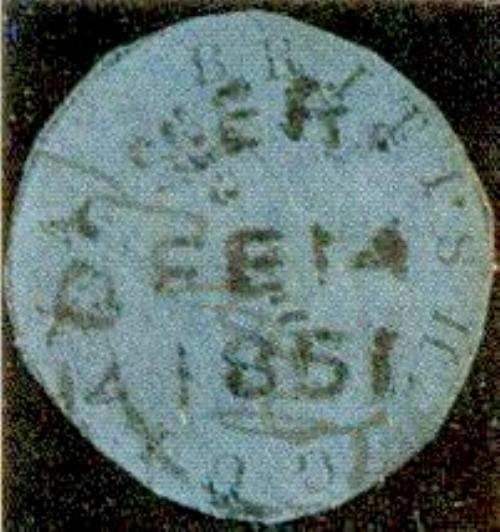
A Bahamian island was one of the West Indian
islands on which Columbus landed. The
Bahamas were included in a grant made to Sir Robert Heath by King
Charles I. However, only
a few settlers arrived from England and Bermuda. In 1783, after a
brief period of Spanish
dominion, the islands were formally ceded to Britain by the Peace of
Versailles. Early postal
history of the islands is obscure. It is probable that, as early as
1733, island mail was included
in the system which operated to and from Jamaica and other West
Indian islands.
The earliest local postmark known is from 1802. In 1842 the Royal
Mail Steam Packet Co.
obtained the West Indian contract. At that time letters were
postmarked with circular markings
containing the town name, and ship letters were marked with 'Bahamas
Ship Letter' in two
lines. A crowned circle handstamp went into use in 1846 to indicate
prepayment of postage.
Like other colonies in the West Indies, British stamps were put in
use after March, 1858, when
the process of moving the postal systems from the General Post
Office to the colonial
governments was underway.
A supply of 1d., 4d., and 6d. stamps was sent to the islands along
with handstamps.
Apparently the practice of using British stamps began before this
time as stamps with the
Nassau A05 oval-of-bars obliterator are known from as early as 1856.
Also, 2d. and 1s.
stamps are known cancelled in Nassau. In 1858, C. J. Bayley,
Governor of the Bahamas, wrote
the Colonial Office in London suggesting that the colony should have
a distinctive issue of
stamps. He included a design suggestion of a circular design of a
'Bahamas One Penny' with a
pineapple and conch shell in the center. He also said the
Legislature had approved an outlay
of not more than £110 for the die.

The matter was referred to the G.P.O. and in
October, 1858, Perkins, Bacon & Co. quoted £84
for making a die, and 1s. per thousand for printing and gumming the
stamps. The circular
design was deemed unsuitable. An alternate design was enclosed based
on the Chalon
portrait of Queen Victoria with pineapple and conch shell motifs.
The design also included a
ribbon inscribed 'Interinslar Postage.' An order for these stamps
was probably placed in
November, and on April 23, 1859, the die was finished. The plate of
60 impressions in 6 rows
of ten was completed a week later. The first supply of stamps was
printed in dull lake on thick
unwatermarked paper. A first printing of 1000 stamps (probably
obtained by cutting one sheet
to provide only 40 stamps) was sent from Liverpool in mid-May, and
reached Nassau via New
York early in June. The accepted date of issue is June 10, 1859. The
plate remained in use to
print stamps for 25 years.
--------------------------------------------------------------------------
Rodolfo / rtvstamps
Resource: (My archives) - M. Williams. Blandford Press Ltd, 1950.
Back to American
Philately
/
Exchange with Collectors from Mexico


|


