|
INDEX
e-mail me

|
Finland's First Stamps
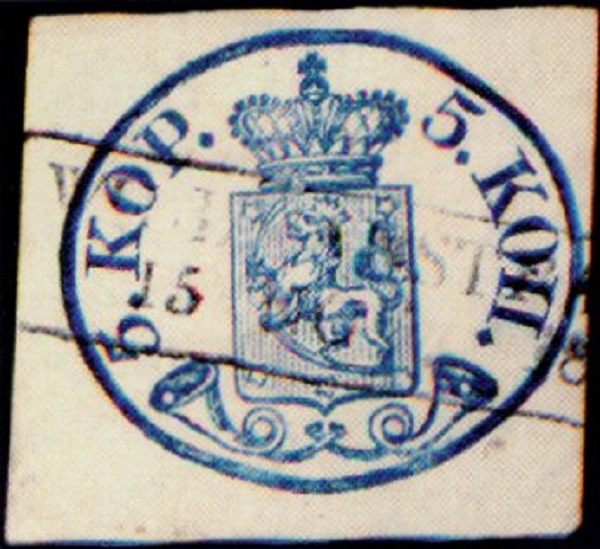
Finland came under Russian control after a short
war with Sweden in 1809. The Russian
Czars ruled Finland until 1917.
Little is known of early Finnish postal history; however, in 1845
stamped envelopes in 5 and 10
kopeck values were introduced. After five years, a new type appeared
and a 20 kopeck value
was added.
On February 26, 1856, a notice was published by the Director of
Posts at Helsinki relative to
an experimental issue and use of adhesive postage stamps. The stamps
could be used for
payment of postage not only within Finland but for mail destined to
Russia and abroad. The
stamps could not be used on registered letters but could be used for
any letters otherwise
mailable. Postmasters were instructed to keep the stamps in
cardboard boxes each of which
held 100 copies.
Dies for two values, 5 kopecks, blue, and 10 kopecks, rose, were
engraved on steel by C. M.
Mellgren. The printing was done by hand at the Kontroll Stampel
Kantor, of the Finnish
Treasury Department. The press was a small, rather primitive lever
press mounted on a
wooden table. The paper was cut into strips and fed into the press
to receive one stamp
impression at a time. As a result the stamps have varying spacing.
The paper strips permitted two rows of stamps to be printed. During
the printing process the
paper had to be reversed resulting in tête-bêche rows. Various
papers were used for the
stamps.
There has been considerable uncertainty about the date the stamps
were first placed in use;
however, March 3, 1856, seems correct. (Saturday, March 1 was noted
in the Kohl
Briefmarken-Handbuch and confirmed by Michel at the time [1950s];
Yvert and Scott were
non-commital and Gibbons gave April, 1856. Facit says that both
stamps were issued on
Monday, March 3, 1856. March 3 is the earliest known usage. Monday
does seem a tad more
plausible.)
Although the notice said that the stamps should be cancelled by the
local postmark, pen
cancellations are more frequent. Cancellations with both pen and
postmarks are also found
and those with only the postmark are the least frequent.
---------------------------------------------------------------------------------
Rodolfo / rtvstamps
Resource: (My archives, Youngblood & Rockwell, 1994).
Back to European
Philately
/
Exchange with Collectors from Europe


|


