|
INDEX
|
Rest of the
World
Philately |
e-mail me

|
Egypt's First Stamps
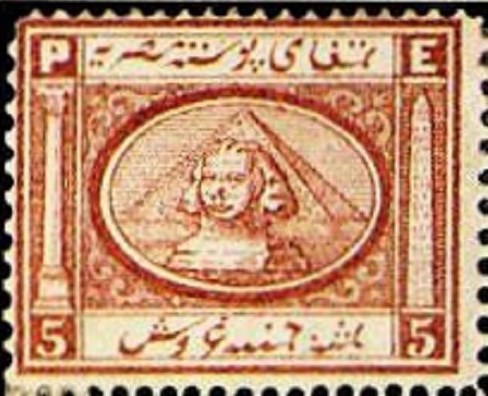
Egypt began 1866 with reforms in the postal system.
The change to use of postage stamps
was announced in a December 21, 1865, decree as follows:
The Post Offices alone are authorized to sell postage stamps.
The postage stamps are of seven different kinds which are
distinctive by reason of their colour
and value, that is to say:
5, 10, and 20 paras . . . 1, 2, 5, and 10 piastres .
Correspondence to foreign countries must not be thrown into the (letter)
box, but taken to the
dispatch window . . . Payments of the postage on letters sent to
foreign countries must be
effected by means of Egyptian stamps for the internal journey to
Alexandria; foreign postage
must be paid in the stamps of the country that is charged with the
forwarding.
Although essays had been produced by a number of artists in both
Paris and London, the
Italian firm of Fratelli Pellas of Genoa was given the printing
contract. The frame design of the
5 piastres value was based on a rejected essay for the first Italian
stamps submitted by the firm.
With the exception of the 1 piastre all the stamps were lithographed
in sheets of 200, arranged
in rows of twenty. The 1 piastre is typographed in two panes of one
hundred. The colored
backgrounds were overprinted in Turkish in black with 'Egyptian
postage stamp' at the top,
'Egypt' in the center, and the value in paras or grousch (piastres)
at the bottom. The overprint
was typographed on the 1 and 2 piastres but lithographed on the
others.
A thin grayish wove paper watermarked with a pyramid surmounted by
stars intended for each
stamp was used for all values except the 1 piastre. The 1 piastre is
printed on thicker white,
unwatermarked paper with a glazed surface. It may have been that
this paper was intended to
be used on the Italian contract which Fratelli Pellas bought in
anticipation.
It is believed that the stamps were perforated and gummed in Egypt.
There is some evidence
that the printer did some perforation although it may have only been
for tests. A variety of
perforations exist with most stamps being off center.
The stamps remained in use until withdrawn from sale August 1, 1867.
The stamps were
demonitized on September 1 but were exchangeable for stamps of the
second issue through
October 31, 1867.
---------------------------------------------------------------------------------
Rodolfo / rtvstamps
Resource: M Williams. Blandford Press Ltd, 1950
Back to Rest of the World
Philately
/
Exchange with Collectors from Europe


|


