|
INDEX
|
Rest of the
World
Philately |
e-mail me

|
Palestine First Stamps
At dawn on December 8, 1917, three British
divisions under General Allenby began an
intensive assault on the Turks in Jerusalem. It was so effective
that at the end of the day the
Turks abandoned the city under of cover of darkness. Allenby
formally entered the holy city
two days later.
Suddenly the army post offices became responsible for handling the
mail for the bulk of the
Palestinian population. The need for stamps to prepay postage soon
became apparent to
replace the Turkish stamps previously used in Palestine.
The Director of the Army Postal Service sent a request for stamps to
the Survey of Egypt. The
selected design was quite unornamental, containing the words 'Postage
Paid' and the Arabic
equivalent in the center and the value in words down each and in
figures in each corner. The
letters E.E.F., standing for Egyptian Expeditionary force, were on
the top and bottom of the
design.
The stamps were produced by photo-lithography at the Typographic
Department of the Survey
of Egypt. Each sheet contained 120 stamps in ten rows of twelve. The
margins had a
surrounding line and a control number A18 beside the next to last
row. The paper was the
same used for then current low values in Great Britain, watermarked
with the Royal Cipher in
columns, supplied by Somerset House. The sheets were ungummed.
Perforating machines
were unavailable so the stamps were rouletted 20.
The 1 piastre in indigo (and several shades as well) was the only
stamp in this issue. The first
printing was made January 15, 1918, in deep indigo.
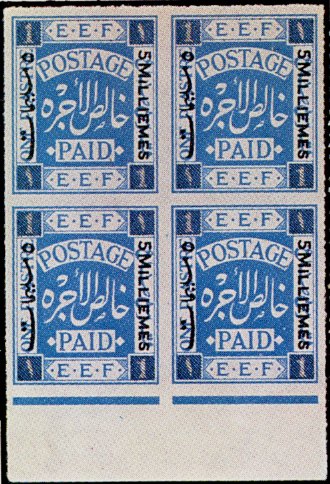
The first printing was 1,948 sheets, or 233,760
stamps. The issue took place on February 10,
but stamps were not sold at the post office counter, instead they
were affixed to letters
requiring them by postal clerks. As a result many people were
unaware of the stamps for
several months after they had been put in use.
---------------------------------------------------------------------------------
Rodolfo / rtvstamps
Resource: Stamps Day By Day, L. N. and M Williams. Blandford Press
Ltd, 1950.
Back to Rest of the World
Philately
/
Exchange with Collectors from Europe


|


